
Radical Futures: Gathering Ground
The Art of Belonging – Mapping Place, Identity and Community in Margaret River
An Essay by Daniela Palitos
Gathering Ground is the name of the Margaret River group exhibition part of the third edition of the Regional Arts Triennial – Radical Futures . A creative engine where regional artists of Western Australia are invited to collaborate and share their stories, insights and visions to embrace and build a more sustainable and connected future.
Gathering Ground is embodied with arduous propositions of how to come together in a fractured world, where values of empathy, humanity and solidarity are carried by those who resist the turn of the tides, and stay afloat fighting the currents of prejudice, division and hostility. The works you will see in this exhibition materialise the artists’ creative responses to subjects of belonging and displacement, identity and memory, community and history, connectedness and collaboration. A group of twelve local artists are introducing their works and concepts through a variety of materials, form and techniques to open cultural consciousness and pave steady pathways through a collaborative effort. These emerge from valuable encounters with familiar and unfamiliar realities, only to come to a realisation of common relationships between local and international matters.
Questions will arise regarding uncomfortable truths. How can we establish a sense of belonging on land that was never ceded? Can we welcome the newcomer without erasing their culture, beliefs and traditions? How much do we need to let go of the past in order to create a prosperous future?
The viewer is invited to delve into these tales and reflect, connect and reimagine these in their own lives. To position themselves within the fragilities of belonging, the obscurities of exclusion, and feel first-hand the erasure of cultural identity. To look beyond the artworks, to understand how art serves as universal language, how it can still transcend cultural barriers, and how it fosters hope to build a cohesive community.
Gathering Ground is inspired by our community in Wadandi Boodja. By the elders, both past and present who raised, built and nurtured remarkable local landmarks resisting development pressures, engaging in conservation and protection of its ecologies, seeding solidarity in noble endeavours, and reflecting their respect and care for this land.
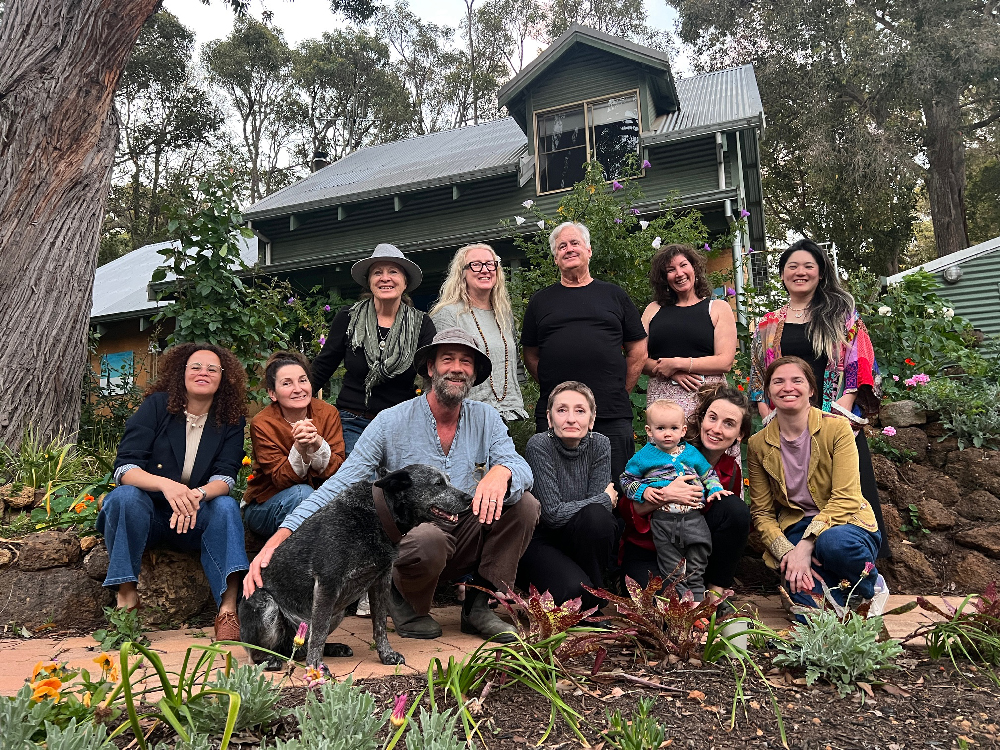
Lastly, Gathering Ground is a result of a three-part collaborative engagement between curators, artists and writer to create a temporary art community envisioning forthcoming partnership. Through visits to the artists’ studios, discussion of concepts, and communal feasts around a table of fourteen, the project deeply engaged with the principles of belonging.
Let’s walk together!
Belonging: in search for “home”
Shelley McNab, Jane Tangney, Cassandra Bynder
Have we ever considered the concept of belonging and its significance? Initially, the answer may seem simple. It’s only by looking deeper and exploring its multiple meanings that we realise how complex and intricate the idea of belonging can be. If for some, belonging is intimately related to a place, both physical and social, for others it can be defined as a state of being or a feeling. The challenge has been set and demanded a collective artistic effort to ponder and mediate within a proposal of what it means to build a safe and welcoming place for all to belong.
Due to the depth and strenuous nature of these themes, it is advisable to observe the works created by the artists participating in Gathering Ground in a more empathetic manner. These artworks are more than objects of aesthetic contemplation. They are embedded with urgent questions regarding the relationship between global and local domains of cultural, social and environmental sense of identity and belonging through art. And while some issues and subjects are similar, the ways of addressing them will reflect the diversity of our group of artists.
If on the surface one might wonder that the idea of using art to uncover and document varied contemporary realities is not new, other will emphasise the role of art as a communicative tool to project and report common experiences.1 Furthermore, art still has the power to incite critical thinking in its audience by exposing a set of rather undecipherable problems and by modelling possible ways of living. Taking an interest in these affairs will bring us into this conversation.
So, if we reflect on how several situations in life had affected our perceptions and personal experiences of home, place and belonging, we will be surprised, or not, to learn how different were the contexts that played a significant role on all the above. This will take us back to the premises raised in the first paragraph of how the ideas of belonging, place and home can be interconnected. Moreover, it asks what textures, contours and flows these interconnections are made of. For instance, American author and social critic bell hooks proposes that belonging is about finding and shaping home – “a place where the soul can rest”.2 This statement not only gives us a romanticised meaning of belonging, but it can also lead to multiple interpretations of home and place.
In her work Where is home?, artist Shelley McNab introduces us to this discussion through her ceramic installation representing Earth, the home of humans. A central spherical orb invites us in to engage in a process of discovery. Outside the orb eight black oil glazed reflection bowls serve as a portal to a dialogue of being. Looking at the water, our image reflects at us with questions we cannot yet answer. A realm of uncertainties and a suggestion of a cosmic introspection in a search for home are now present before our eyes. A state of awareness where according to the artist, home is found within us by unveiling who we are, where we come from and where we want to be. McNab’s approach has led her to develop a form of relational art,3 where personal interaction adds another layer to the artwork, imbuing it with an intrinsic meaning. The use of local clay is intentional and can be interpreted as a statement of belonging and deep respect for this region. If we look closely, the surface of the orb has a distinct texture which adds a sensorial dimension to it, revealing local minerals such as feldspar and granite, and its warm peachy blush colour is a result of the shino glaze. In relation to the eight reflection bowls, it is relevant to highlight not only their rounded toroidal form, which accentuates their symbolic and cosmological design, but also the colour contrast between the darkness of the concave top and the lateral creamy-white brush marks. This contrast emerges from the combination of the glazes, minerals and firing techniques used during the artistic process.
In line with McNab’s proposal, home is now a richer and more complex concept. As we expand our consciousness from looking inwards, how are we able to connect to our surroundings? In other words, how can a place and its landscape influence and reinforce our sense of being? It can be argued that engaging with a physical environment fosters a sense of self, which in turn cultivates a feeling of home and belonging. When looking into Gathering Ground – Home, Shape Shift – Kubota and Shape Shift – Metamorphosis by Jane Tangney, we become suspicious of the transformative powers that are ingrained in the local rural landscape. Seen from above, Tangney exposes her relationship of care for the place where she is re-building home through learning from farming legacies, especially the ancestral farming legacies of this land’s traditional owners, the Wadandi Pilbelmen peoples. On closer analysis, we can see it all: the rejuvenated creek line, the bush block, the sandy driveway, the red Kubota in action and the soaring trees at the top. Organic shapes and textures are imbued with joyful and tender colours that witness the vitality of new cycles of the land and of life. The expressionistic effect of the paint is achieved by the artist’s preference for mixing natural earth pigments and oil paint with beeswax which adds a visual fluidity to the compositions and a tangible feeling of homeliness. By using plywood as a structural support in the two later works, she facilitated the design of their natural forms and consequently, emphasised her engagement with this landscape. The apparent simplicity and lightness of this artistic assemblage is not subjective. In times of crisis where a strong sense of ownership and boundaries are pushing us into extremes, Tangney asks us to reconsider our connection to space and reevaluate notions of time to understand what is most valuable in our lives. The chaos and the hectic pace of living are now superseded by a state of stillness and quietude.
This idea of re-establishing the concepts of time and space by reinforcing a culture of affections and respect for the land can also spark a collective sense of belonging. In Koori Miya (a heart, a home), Cassandra Bynder is restoring her idea of home by embracing and reinstating the ancestral knowledge she has inherited from her elders. Three panels of large imposing canvas descend from above. Through gaps made of burnt holes and shredded material, we glimpse painted drawings revealing stories of community displacement and family tales reminiscent of an ancient cave. At the bottom, a shallow pool of water surrounded by stones and assigned seating alludes to the indigenous symbols of a campfire. The red and orange colour with a smudge of black relates to Country and to fire. Despite all the risks that a fire conveys, we are still drawn into it, to look closer and discover all the finer details. This is not a threat. On the contrary, it is a site of emotional connections, a place filled with warmth and care that offers nothing but safety. In Noongar language, Kaarlak /Karlup means campfire, but can also mean home or sometimes heart Country. For Indigenous cultures, this is the most important place where family come together and care for each other. Here rests the survival of a community, gathering ground to create a safe and harmonious haven. The understanding that, just as nature weaves new life after a bush fire, people also can mend their lives anew, carrying the strength and resilience to start over and shape new home is evoked in the artist’s words:
“Every thread I pull from this canvas
Removes from me a thread of power over me
As I embrace change and transformation
And the power of the power within.”
Cassandra Bynder
Belonging versus Displacement
Michael Wise, Katharina Meister, Yu-Hua Lan
One of the curatorial principles of Gathering Ground was that artists could explore different concepts of belonging, including tensions, dilemmas and constrains associated with the main theme. Evaluating by the diversity of the works presented in the show, numerous artists critically exposed the structural fractures relevant to the subjects under analysis, exploring their tensions, uncovering tenacious acts of cultural erasure, the consequences of migration and coerced displacement. While some reflected over their own experiences, vulnerabilities and struggles, others embarked on a more analytical and fantastical approach.
One such example is Michael Wise’s immersive art project The Sky is not my Home, where many of these perspectives are analysed through a series of metaphors and ideas inspired by gothic fantasy. A story of a bird in distress, flapping its wings on the ground after suffering a trauma and falling into a foreign environment. Across its various components – a story, video, sculpture and installation – the work reflects on the ideas of displacement and loss of identity. The bird is no longer in his natural habitat, but at risk in an unsafe environment. A primary inspiration for this work were two local tragedies where two men, on separate occasions, drowned while trying to rescue their dogs from the Barret Street weir. In Wise’s original story Dog Boy Drowns, a boy also submerges after trying to save his dog, only to reincarnate as a bird. This human-like transformation is showcased in three short videos on exhibit linking the visual and conceptual elements of these artworks. Another relevant feature of this ensemble is the installation Rain of Feathers, a floating structure composed of bird netting and feathers collected in the forest by the weir, and coloured plastics illustrating materials gathered by birds for their nesting. The Sky is not my Home is an evocation of local history, staged by the display of images of Margaret River where the story takes place, and reflects on present-day issues such as cultural diaspora and erasure of cultural heritage.
This discussion is valid to both the current global and local contexts. The trauma of displacement is often associated with the phenomena of mass migration, driven by political crises such as war, famine and oppression, as well as climate change and natural disasters, or social and economic instabilities. A shifting process which is challenging and can throw us into deep isolation, anxiety and distress. Are we welcomed and embraced for who we are, or must we conform to belong? Italian author Giovanni Perillo in The Art of Displacement 4 asks us to consider what displacement means. He creates an open dialogue between displacement and migration movements. How do we welcome the newcomer without reservations? Perillo suggests we take a step back to reflect on our preconceived ideas about the other to avoid the creation of prejudices and stereotypes. To be curious instead of fearful, accept with kindness and not with judgement, to embrace the shift to create new pathways for connection and inclusion.
The personified representation of a human-to-bird was sough to emerge again in Connecting Worlds by Katharina Meister. Combining video and installation, Meister meditates on her personal story as a migrant and her journey of finding belonging in Western Australia’s Southwest through learning and connecting to the local natural environment. A recreation of a WA forest, with tall trees made of pond liner serves as a scenario for the artist’s narrative that aims firstly, to document the difficulty of connection between human life and nature, and secondly through the projection of a video animation to bring hope into the reconciliation between people and nature. The visual experience is heightened through a work of light and shadow, which creates an intrinsic mood deepening the contrast of the themes explored by the artist. Like many other projects presented here, Connecting Worlds is an ongoing work, with plans to incorporate an audio component in future presentations. This will feature the sounds of the forest – wind, rustling leaves and the screeching of cockatoos – enhancing the immersive experience.
This intricate and complex interrelation between humans, their cultural and social norms, and the ecological systems which they are part of, has been a major debate of human ecology.5 One of its arguments is the fact that human-environment interactions are increasingly problematic due to contributors such as pollution and biodiversity loss, deforestation and depletion of natural resources, and climate change. Katharina Meister questions whether people failed to see themselves as part of nature as they regard it as something separate from their own being. Connecting Worlds analyses these complexities as it wavers from dark scenarios, where we are alerted to the risks of our disengagement and displacement within the natural world, to brighter outcomes of an interconnected future.
It becomes an ethical question, an effort from a community to embrace and learn better practices for ensuring the preservation and sustainability of the ecosystems that are vital to us all. Engaging with nature and becoming part of it can also sprout a feeling of belonging. With her work, Meister advocates for the benefits of an interrelationship of care and mutual respect, a better realisation of living well and self-care, which must draw upon the teachings, wisdom and experience of the Indigenous peoples who are part of this land.
Katharina Meister was not the only artist to seek a sense of belonging through the local ecologies. In Whispers That Shaped Me, Yu-Hua Lan also addresses the fragilities and the different layers of belonging. She contemplates how identity, memory and emotional disruptions can be shaped by her personal migration story and the power that a place can bear. From displacement and cultural barriers to a path of discovery and inclusion through the contact within the natural surroundings and its natural resources. Each ceramic element holds tangible memories that crossed continents into foreign soil. Where we come from, who we are and what we have learned can be carried into new places, introduced to new people. Should our identity be untouched on arrival and grow into the newer environment? Global echoes of cultural assimilation and adaptation into new traditions are under discussion. While many politics of intercultural governance believe that an idea of social cohesion needs immigrants to adapt and abide by the traditions and cultural heritage of a new place, researchers find it difficult to agree that a sense of belonging and genuine affection for a country can be done by a process of nationalising an individual.6
Although this subject sits emotionally strong and quietly resolute, Lan’s work could foster a possible way forward into this debate. Much like in Meister’s work, the suggestion of regaining the systems of care and attentiveness to her surroundings by mimicking some of its natural shapes – seed pods, bark fragments, weathered husks – is Lan’s response to seeking belonging to this region. Blending her multicultural artistic techniques and expertise to portray the local landscape, the artist is embracing this land and its community. Whispers That Shaped Me is a ceramic immersive installation consisting of a series of delicate sculptural forms made of porcelain and wild clay, sourced locally as an honouring gesture and deep respect for this ancestral landscape. An imprint of karri and jarrah bark onto these surfaces enhances its textural richness, evoking a tactile experience. A notable mention is the larger sculpture positioned above, calling to mind the crystalline descent of a stalactite in its shape and colour, glowing from within like fluctuating sudden memories or thoughts. All the narratives and visual objects are intended to be consolidated through an audio element featuring whispered spoken Mandarin and English languages spreading through the space as an evocation of the multilayered presence of the region’s stories. Just like many of us, migrants or locals, these shapes have the right to be seen, touched and cared for. The subject is complex and fragile like her ceramic sculptures but needed to be discussed and reflected upon.
Belonging and Identity
Ana Brawls, Moritz Müller, Shayne Hadley
Can old and new coexist without friction? Is there place for a whole world to live in harmony? According to bell hooks,7 when we follow a narrative based on the ethics of care and acknowledge the complexities of our own identities, we open a possibility to live in harmony with each other and with all living beings, regardless of where we come from, creating a new sense of belonging. For many, this view is rather utopian and out of sync with our divided world. For others, it carries hope and involves a positive encouragement of encounters between different social, ethnic and faith groups opening the dialogue of interculturalism.
Furthermore, internal conflicts between our values, beliefs, and perspectives often begin to surface in our minds particularly for immigrants who have left an entirely different world behind. In Reflection of Us, Ana Brawls accelerates this conversation and reflects on identity and memory, and how invisible currents have shaped us. Listening to the poem, we are invited by the artist to ponder our existence as a starting point of a long and tumultuous journey. It reveals a migrant perspective, not only Brawls’ but “…me and you and us ” who come from beyond the horizon. As the artist describes “We find hands to hold …” within our support network of friends and family, within our communities to overcome the moments of solitude and nostalgia for other homes and places, and to “redefine ourselves .” This phenomenon is neither unique nor rare, as individuals continually shape and re-shape their identities by navigating various cultural and social frameworks. But how do we “… steady our balance ”? Apart from seeding roots into new soil, it is important to explore new principles of connection to create a bridge between the old and the new, our past and our present. Reflection of Us is a three-part installation in which spoken word engages with performative and participatory elements involving the public. We are invited to step forward and gaze at our own image on the reflective surface on the wall while listening to her words. Additionally, a written version of the poem in concrete poetry is within reach introducing an aesthetic layer to this multisensory experience. The rhythmic dynamism between words, letters and phrases reinforces the viewer’s physical involvement with the work and its explorations of motion, as it unfolds as an ongoing journey for gathering ground. With these extensions, Brawls aims to provide audiences with a fully immersive experience that encourages reflection on concepts of time and space, as well as the vulnerability of life and existence, origins and their meaning.
And if it is true that “We all come from beyond the horizon /Leaving traces, spectres of our existence” as Brawls speaks to our conscience, when do we permit ourselves to fully be present in the moment? This creates a sense of tension and unease within a two-dimensional facet: presence and absence. In POSITIVE DEPRESSION – Waiting & Coming, Moritz Müller explores the dual relationship between waiting and coming of both place and people. A sculptural dialogue among position and negation, an encounter with the true beauty of negative space. It reflects the awareness of one’s physical presence while considering the memories, places and possible futures that shape our consciousness. Using the artist’s words, “Wherever you are now, all other places are waiting.” As we look closer into his work, a square ceramic structure with two identical incisions in the centre of the piece serves as a gateway for this duality of waiting and coming, positive and negative, plus and minus. A solid bronze cube determines whether you remain or depart serving as a judge of your own presence. Through our gaze, its weight and permanence stand in stark contrast to the transient, uncertain nature of those seeking a sense of place, highlighting how belonging can be determined by something as arbitrary and impersonal as an object, a border or a law. Attention should be granted to the creative process of this artwork. Its minimal style and aesthetics withhold a complexity in subject drawn from the artist’s own experiences. The use of local clay stresses Müller’s interrelationship between geography and natural materials, as well as allows the artist to embrace a certain unpredictability inherent to working with ceramics.
The cube’s implacable authority is a reminder that our search for identity and acceptance often hinges on decisions and boundaries beyond our control, inviting us to reflect on how we might reimagine these boundaries to foster a more inclusive and compassionate sense of community. It is within us to live in a community as we evolved to cooperate with one another. Australian psychologist and social researcher Hugh Mackay illuminates that human beings depend on communities, as we are not well suited to survive in isolation.8 Furthermore, Mackay argues that although we count on communities, and how these need us to thrive, we are individuals with a rich sense of personal and social identity that is driven by our wish to connect and to belong.9 If Ana Brawls and Moritz Müller unravelled the complexities of navigating life between two points, how can we form a connection between our personal selves and our social identities?
In bark: works in process, Shayne Hadley exposes this juxtaposition of the individual internal being versus its social nature. Inspired by Buddhist teachings and beliefs, Hadley explores the idea that we are internally hollow, evoking humbleness in contrast with our external essence exposed to the different social, cultural and natural environments. This work is composed of four pieces of matured, robust sculptural timber with larger and smaller openings across their forms. These openings function both as an invitation to peer into the void, and as a metaphor reflecting our dual nature. The dark colour or burnt finishing observed inside some of the sculptures derives from the application of a traditional wood preservation process used by Japanese cultures – shou sugi ban – and Indigenous Australians. This not only extends its longevity by reinforcing and straightening the timber but also imbues it with an aesthetic element.
The impact of this work stems from its majestic and opulent presentation, along with its lyrical connection that forms between personal experience and artistic process. Inspired by observations of human physical and mental decay, Hadley supports this idea by deliberately selecting a rescued and locally sourced Norfolk pine that forms the base of the sculptural group. Just as the shedding of bark allows a new cycle of growth, a similar principle applies to Hadley’s artwork, guided by trusting the creative process to achieve its ultimate form. The use of timber with natural and historical references10 was also meticulously thought to accentuate the statement of the artist’s connection to place and home, namely the southwest region where he is (re) building a sense of belonging and rootedness.
The Future of Belonging
Elisa Markes-Young, Kate Alida Mullen, Carmen Griffen, Moritz Müller
Another curatorial principle of Gathering Ground is to foster the idea of connection and collaboration as a reminder that the future is something that we can create together. Across distinct periods and varied contexts, art practice has aspired to secure humble connections between artworks and their audience, to open ways that were otherwise closed to critical thinking and to promote a shift in mentality. For this exact reason, we see contemporary art as a generative place for social experimentation speculating about the events of tomorrow. As French art critic and curator Nicolas Bourriaud observed new concepts of art emerged with a focus on more interactive and participatory works of art because of this social and cultural shift.11
Although we live in an era of fast-paced technological advancement causing worldwide cultural revolution, and see its impact on art production and diffusion, there is still space to recognise and respect art forms from the past and from other cultures. It is also well documented that art has always been influenced by sustained cultural contact. But it might be still relevant to question the role of art in breaking down cultural barriers. Moreover, it might be relevant to ask if a universal concept of art is shared within different cultures.
Observing the group of artists selected here, we realise that most of them, if not all, share a number of similarities. Apart from the fact that all are artists, who live and work in the southwest region of Western Australia, many discuss within their practice and artworks their diverse cultural background. Collectively, they aim to articulate their artistic proposals for promoting harmonious coexistence, both within the local community and across a broader global context.
In The welcome of unfinished things (Loom), the artist and curator of Gathering Ground Elisa Markes-Young together with long-time collaborator Ruth Halbert, weave their materials mimicking the laborious toil of forming inclusive communities. The work consists of a large panel composed of narrow woven segments that are meticulously sewn together. While sharing the same colours – alternating between olive and forest greens, varied shades of blue, grey and red, with yellows, ochres, white and bright orange used to accentuate contrasts – the woven segments display distinct patterns suggestive of new stories. As we draw closer, the use of different yarns and techniques to create a textural depth highlighting the idea of diversity and interconnected narratives becomes perceptible. Once again, the choice of material and its support is not arbitrary as the nature of textiles is integral to the concept of this work. According to the artist, textiles and weaving convey connection, fragility and resilience. Parts of the weaving have been left deliberately unfinished as a metaphor for the continuous nature of building a sense of belonging and home. The warp threads (long yarn running vertically) represent stability and strength of home, while the weft/woof threads (yarn running horizontally) symbolise movements of migration, adaptation and cultural exchange. The inclusion of a heddle and an additional warp chain hold space for new potential stories to be woven.
Matters of cultural preservation and tradition are also present in this work, starting with the choice of medium. It can be interpreted as a means of reversing cultural erasure and the cycles of rapid change. The power of tradition is also reinforced by author and curator Ariella Aïsha Azoulay, who argues that tradition can be sustained across successive generations as can the “…preservation of worldly knowledge of being in the world’.12 As we mentioned before, the status of global uncertainty and unrest is creating space for healing and repair. In her work, Markes-Young left unamended gaps of loose and broken threads as a token for the displaced, dismissed and for those suffering from loneliness. Other holes have been attentively mended to honour repair and growth. This idea is much aligned with the Japanese concept of kintsugi,13 the art of repairing. Usually applied to the restoration of ceramics, the philosophy of kintsugi acknowledges damage and mending as part of an object’s history and values the signs of its use. Despite differences in medium and format, we could say that Kate Alida Mullen’s work echoes similar concerns to Elisa Markes-Young’s, as both carry the perception of a fragmented system in need of repair and care, and hold faith in the creative process and interconnectedness as a path forward.
Amid global divisions and segmentation, Kate Alida Mullen exposes the cracks in the foundations of our social, political and ecological structures, and queries how much these affect our minds and identities, and how individuals can cope with this situation of precarity. Furthermore, the artist questions whether attaining true integrity involves accepting the prevailing fragmentation? Like Markes-Young, Mullen’s choice of working in a traditional artistic medium was critical and decisive in emphasising this contrast between fragmentation and integrity. Titled Decomposition I and Decomposition II, these artworks comprise a sequence of botanical studies that manifest a deep analogical portrayal of the lifecycles inherent in artistic objects and processes. The coarse weave of the Belgian linen reinforces a sense of organicity, while providing a more layered texture of the paint enhancing its proximity to the subject’s intrinsic colours and materiality. The employment of the “roving window” technique14 enabled an exploration of finer details, serving also as a reflective and contemplative method that reoriented the progression of these works.
Decomposition I and II are then, a combination of conceptual and performative aspects which are not all accessible at once, but they all share the same space. Through this action-painting, Mullen explores the process of disruption by physically cutting her canvas apart and breaking its frame as to reflect the turmoil within the systems we inhabit and the threats this poses to our integrity. As the artist notes, it is urgent to take responsibility and care for each broken piece, to allow time to grieve and process each tear, before reimagining their reconstruction. Only then will we be ready for the following stage: that of transformative repair and a healing process by manually (re)connecting all the canvas pieces together as a therapeutic and resistive act. In every patch lies an opportunity to recover and regain our truth, clarity, empathy, and communal connectedness.
As becomes clear, art has not only the potential to raise awareness of difficulties we face within an increasingly precarious world context, but it can also provide places of conviviality and encounters. It can involve gatherings guided by various intentions such as religious, spiritual, social, economic or purely artistic. A fine example of this is Indigenous Australian art which has embedded over generations of artists the concept of communal art practice, where everyone sits together to paint their stories. Stories of belonging, tales of a deep-rooted connection with home and Country making it the centre of their artistic practice by portraying rivers, mountains, rock formations, the sky and other defining elements of the landscape. This intimacy and familiarity with our surroundings have been extended into modern art by drawing attention to everyday items – highly recognisable objects capable of safeguarding memories of household-based cultural traditions.
In Home Gatherings by artist Carmen Griffen, we have the best of both worlds. On one side, an artwork inspired by a sense of place and gathering, and on the other, a work able to evoke nostalgia and comfort. At first glance, the seemingly simple nature of a paper bowl with spoons and its relational character may cause a mixture of wonder and intrigue. But as we approach it and begin to peel away the layers of recycled flour bags and paper, peer through the vintage recipe sheets also naturally imprinted in the artwork, we realise there is more to unveil: memories of family reunions, of generational encounters, the passing on of traditions and rituals carried on over the years, conversations and discussions over a meal, the making of something together. In Griffen’s words, Home Gatherings is a reflection on everyday items that stir up mementos and stories of gatherings around a kitchen table, the hand-me-down recipes we all bring to the table on special occasions. A welcoming ceremony and a rite of connectedness that is transversal to different cultures around the globe deeply ingrained with community values of gratitude, generosity and communion.
The conviviality narrative present in Griffen’s work can also be observed in The welcome of unfinished things (Table) . Inspired by the urgency of belonging, Elisa Markes-Young reimagined a communal feast with the display of an oversized cotton tablecloth. Once more, Markes-Young focused on traditional techniques such as embroidery to emphasise the theme of cultural preservation and identity, and to explore the meaning of continuity and perseverance found in the artistic process. Images of plates and cutlery stitched in cotton and metallic thread symbolizing an act of commensality are interspersed with blank spaces suggesting an open invitation to newcomers. This dual nature of the work is accentuated by the marks and traces of a participatory gathering that occurred during a pre-exhibition event where the curators, artists and writer involved in Gathering Ground invited the local community to gather and share a meaningful meal and their stories with the intention of fostering inclusion and interconnectedness. The welcome of unfinished things (Table) thus became a testimony to the enduring labour of belonging and holding space for each other, and an expression of the vulnerabilities, diversity and strengths of our community. A ‘home’ of hope for an approaching future.
Reflecting on the artworks mentioned above, we could argue that the future of belonging can be interrelated with the miracle of connection within a community.15 Since sharing a meal with a group of people is a social act,16 it may be guided by feelings of solidarity and care, bonding, compassion and cultural memory. The abundance of cultures, local and international, that have contributed to the creation of the community where we live, could play a significant role in its resilience and determination, especially following challenging events. Its transient nature does not interfere with its sense of connection to the land, neither with its sense of communal and social living. If, as Hugh Mackay says,17 the place where we live matters, we may ask if a place can influence artistic practices? 100 BUNNY TAILS On the hunt for the Blow-ins, Moritz Müller might have inadvertently answered this question. As seen in the projects of other artists, and Müller’s own previous work, the use of one hundred Lagurus Ovatus, commonly called as hare’s tail grasses or as “blows”, sourced from our coastal area and individually attached to a square block of jarrah wood, reaffirms his sustained engagement with the regional landscape, and expresses his intention to reveal the material in its purest form. It can be also interpreted as the artist self-portrait. Just as the hare tails are identified as an invasive weed in Western Australia, Müller positions himself as a “blow-in” exploring the significance of belonging and the perception of being an invasive presence.
In terms of his methodology, the core principles to Müller’s architectural practice, such as rationality, pragmatism, order and symmetry are carried into the formative phase of his work. As the process unfolds organically within its conceptual, formal and compositional aspects, it creates space for the artwork to evolve autonomously, consequently introducing an element of uncertainty. Furthermore, its whimsical title could suggest a symbolic reading of the region’s nomadic history.
Beyond the idea that places and their communities can shape artistic practices, there is the need to recognise the role of art as a powerful bonding agent. Not only through principles of sociability and interaction between the artwork and its audience, but also through its capacity to bring together a group of artists in the development of alternative concepts – such as home and belonging.
Conclusion
In concluding our exploration of the multiple dimensions of belonging, it is important to reflect on the objectives and accomplishments of this exhibition. A key aspect to remind our readers and the viewers is that this essay was composed throughout the creation of the artworks, drawing from studio visits and insightful discussions with the artists participating in Gathering Ground . Seeing the works in progress, following and understanding their authors conceptual process and creative effort to respond to the brief reinforced the collaboration between artists, curator and writer, one of the aims of this project.
An additional intention was to bring into this debate the complexities of defining home, identity, memory and belonging through a wide variety of artistic languages and narratives, while embedding them in a wider social and political context. The inquisitive nature of the works underlines the urgency of this discussion emerging from both global and local realms, and their participatory character draws the audience in to elaborate a collective meaning. As viewers, we become integral participants in these experiments: witnessing the solitude and trauma of a bird stranded at the roadside; sharing the joy and anticipation of establishing a life in the country; sensing the warmth and communal spirit of an Indigenous Kaarlak/Karlup ; confronting the existential impasse of living between two worlds; or embarking on a metaphysical search to find the meaning of home.
Our critical reflection on the Gathering Ground art project has, we hope, underscored the relevance of art to address significant issues we face as a group and as individuals, and its capacity to announce and anticipate future possibilities. Beyond revealing its role as a space for encounters, it has also shown its contribution to promoting intercultural exchange. As philosopher John Dewey once said, understanding these works as “the best possible window into another culture”18 facilitates the development of interconnected networks across diverse communities. Another focus of our analysis was the centrality given to the use of locally sourced materials, which form part of the overall conceptual and aesthetic approach, acting as a medium for connection to this place. The sense of incompletion that looms over this collection emphasises the initial idea of presenting not a finalised utopia, but a narrative of belonging as an evolving process.
Looking into the future of belonging, proposals for communal gatherings, transformative healing and community cohesion emerge as the most promising avenues. And as British social anthropologist Mary Douglas speculates, the idea of home as community can be complex, fragile and easy to subvert, but it ultimately enhances the collective interest.19 This imaginative analogy is valid: as in any well-functioning home, a thriving community should foster inclusivity and acceptance, facilitate communication amongst its members, and ensure equal access to resources to build a safe, generous and hospitable environment for all to call home.
Finally, the broader triennial theme of Radical Futures aimed to strengthen the idea of collaboration, nurture creative connections among communities in regional areas and instigate critical reflection on ways to move forward. The stories and visions shared in Gathering Ground, as observed, align with this primary theme, extending it into the local context to shape a sense of hope for the future. A special acknowledgement goes to our curator Elisa Markes-Young for her unceasing effort in uniting these narratives, for her guidance and openness regarding different artistic concepts, and for serving as the driving force in cultivating a creative community in this unique region.
Footnotes
1 This was a discussion by philosopher Suzanne Langer mentioned by Mary Douglas in her essay titled ‘The Idea of Home: A Kind of Space’, Social Research, vol.58, N.1, Spring, 1991.
2 Found in bell hooks, Belonging: A Culture of Place, Routledge, 2009.
3 Relational art – refers to ‘Relational Aesthetics’ a term popularized by French curator Nicolas Bourriaud in 1998 to describe the art practice based on human relations and interactions, and their social context. In its essence, it defines a form of art that places human relations at its central subject, urging the audience to engage as active participants. To see more Nicolas Bourriaud, Relational Aesthetics, Les Presses du Reel, 1998 (translated by Simon Pleasance; Fronza Woods; participation of Mathieu Copeland).
4 Giovanni Perillo, The Art of Displacement, Transnational Press London, 2020.
5 To find more about human ecology search Carleton B. Christensen, ‘Human Ecology as a Philosophy’, Human Ecology Review, The Australian National University, vol.20, 2014.
6 In Ali Rattensi, Multiculturalism: A Very Short Introduction, Oxford University Press, Oxford, 2011.
7 In bell hooks, Belonging: A Culture of Place, Routledge, 2009.
8 To find more search Hugh Mackay, The Art of Belonging, Macmillan Publishers Australia, Australia, 2015.
9 Hugh Mackay, The Art of Belonging, Macmillan Publishers Australia, Australia, 2015.
10 The story of Norfolk Island pine tree begins with the arrival of Captain James Cook in 1774. When he saw the towering height of the pines, he thought to use its timber for the masts of the Royal Navy. But as the first convicts and settlers would witness later, the wood from the pines was far too brittle to use it as ships masts due to its demanding conditions. To see more in Felicity E. A. Cutten, The Story of Norfolk Island, Queensland Science Network, 2025.
11 Nicolas Bourriaud, Relational Aesthetics, Les presses du reel, 1998 (translated by Simon Pleasance; Fronza Woods; participation of Mathieu Copeland).
12 This citation was found in Ariella Aïsha Azoulay, Potential History: Unlearning Imperialism, 2020.
13 In Tiago Jose da Mota Cerveira Nazulino Gonçalves, Kintsugi as a Design tool: artifact, emptiness and sustainability, Évora University, Évora, 2019.
14 The ‘Roving-window’ technique is originally used in raster GIS operations and image processing. Here Kate Alida Mullen adapted the term and used it as a similar approach by physically moving a cut-out card frame across her paintings to depict each “cell” at the time, until the whole area of the canvas was covered.
15 In Hugh Mackay, The Art of Belonging, Macmillan Publishers Australia, Australia, 2015.
16 Tan Chee-Beng, ‘Commensality and Organization of Social Relations’, in Commensality: From Everyday Food to Feast 13, 2015.
17 Hugh Mackay, The Art of Belonging, Macmillan Publishers Australia, Australia, 2015.
18 This citation from John Dewey’s was found in an excerpt from his book Art as Experience (1934) in a short essay by Cynthia Freeland, Art Theory, A Very Short Introduction, Oxford University Press, Oxford, 2001.
19 In Mary Douglas,’The Idea of Home: A Kind of Space’, Social Research, vol.58, N.1, Spring, 1991.
Bibliography
Azoulay, Ariella Aïsha, Potential History: Unlearning Imperialism, Verso London-New York, 2019.
Bachelard, Gaston, The Poetics of Space – The classic look at how we experience intimate places, Beacon Press Boston, 1994.
Bell, Amber Creswell, Clay, Thames and Hudson, Australia, 2016.
Bell, Amber Creswell, A Painted Landscape: Across Australia from Bush to Coast, Thames and Hudson, Australia, 2018.
Bourriaud, Nicolas, Relational Aesthetics, Les presses du reel, 1998 (translated by Simon Pleasance; Fronza Woods; participation of Mathieu Copeland).
Chee-Beng, Tan, ‘Commensality and Organization of Social Relations’, in Commensality: From Everyday Food to Feast 13, 2015.
Christensen, Carleton B., ‘Human Ecology as Philosophy’, in Human Ecology Review, vol.20. N.2, The Australian National University, 2014.
Cutten, Felicity E. A., The Story of Norfolk Island, Queensland Science Network, 2025.
De Wachter, Ellen Mara, Co-Art: Artists on Creative Collaboration, Phaidon, 2017.
Douglas, Mary, ‘The Idea of Home: A Kind of Space’, in Social Research, vol.58. N.1, Spring, 1991.
Freeland, Cynthia, Art Theory: A Very Short Introduction, Oxford University Press, 2001.
Gonçalves, Tiago Jose da Mota Cerveira Nazulino, Kintsugi as a Design tool: artifact, emptiness and sustainability, Évora University, Évora, 2019.
hooks, bell, Belonging A Culture of Place, Routledge, 2009.
Keulemans, Guy, ‘The Geo-cultural Conditions of Kintsugi’, in The Journal of Modern Craft, vol.9, Issue 1, 2016.
Kwaymullina, Ambelin, Living on Stolen Land, Magabala Books, 2020.
Mackay, Hugh, The Art of Belonging, Macmillan Publishers Australia, 2015.
McIvor, Roy, Cockatoo – My Life in Cape York, Magabala Books, 2010.
Perillo, Giovanni, The Art of Displacement, Transnational Press, 2020.
Rattansi, Ali, Multiculturalism: A Very Short Introduction, Oxford University Press, 2011.
Sculthorpe, Gaye & various, Indigenous Australia: Enduring Civilisation, National Museum of Australia Press, 2015.
First published in January 2026 by Christopher Young and Arts Margaret River, 47 Wallcliffe Road, Margaret River WA 6285
www.artsmargaretriver.com
Published in conjunction with the exhibition Radical Futures: Gathering Ground, held at Nala Bardip Mia – Margaret River HEART, January 8 – February 3, 2026.
This publication is copyright and all rights are reserved. Apart from any use as permitted under the Copyright Act 1968, no part may be reproduced or communicated to the public by any process without prior written permission. Enquiries should be directed to the publisher.
© Arts Margaret River 2026
Title: Radical Futures: Gathering Ground
Subtitle: The Art of Belonging
Author: Daniela Palitos
Curator: Elisa Markes-Young
Mentor/Designer: Christopher Young
Artists: Ana Brawls, Carmen Griffen, Cassandra Bynder, Elisa Markes-Young & Ruth Halbert, Jane Tangney, Kate Alida Mullen, Katharina Meister, Michael Wise, Moritz Müller, Shelley McNab, Shayne Hadley, Yu-Hua Lan
Contact Us
Phone: 0421 974 329 (Chris)
Email: write to us!
Newsletter: Subscribe
Web: zebra-factory.com