introduction
With my cross-cultural biography (born in Poland, grew up in Germany,
in Australia since 2002) my identity is punctuated by the question
of how Polish or German I really am.
It is also very much defined by the feeling of being caught between
two worlds. After multiple migrations I don't really belong anywhere
and live between the worlds - the here and there, the now and then.
Living between worlds is a fractured existence, often challenging,
yet always creative. The question is the balance between fitting in with
your surroundings and cultivating your own uniqueness.
Like everyone I feel comfortable when I fit in - we define ourselves
through memberships to groups and comparisons to others. We need to join
a group and we need to conform. Conforming signals: I am like you.
At the same time distinctive differences are considered a fundamental
part of one’s sense of identity. The basic need to belong and fit
in competes with the fear that the differences will be lost and with
the need to defend and preserve the uniqueness, the culture and the history
that shaped us. On the other hand, if we define our identity in relation
to our past and hold on to it we face isolation. But how far can and
should we go in our pursuit of acceptance?
We constantly re-examine and redefine ourselves and never more so than
when departing. Departure means potential isolation. Before we establish
new networks on arrival we have to be accepted. To be accepted we have
to conform to rules we don’t know, often don’t understand
and sometimes don’t agree with.
The excitement of living in a foreign country is accompanied by an intense
feeling of displacement. Being a stranger, having to master another language
and the mentality of a new place creates a feeling of insignificance
and inadequacy. While trying to navigate between my Polish origins, German
influences and Australian surroundings, I realise that the possibilities
to ignore one’s history are limited and one's identity is mostly
a 'handed down' one, shaped by inherited values, norms and ideas.
It takes time until you feel like you belong anywhere completely. The
place that gives you a sense of home isn’t necessarily a physical
space although it can be geographic. It’s more a psychological
state.
While working on my 2006 series What
I Am I recognised not only how
much I myself have been shaped by my history but also how much my past
influences my work.
It was a journey of rediscovery and led to an in-depth examination of
the nature of memory.
Although I consider myself German when developing the language for my
recent work, I chose elements of the Polish landscape, because as these
years lie furthest in my past they are my ultimate motifs of memory.
|
18th tamworth fibre textile biennial
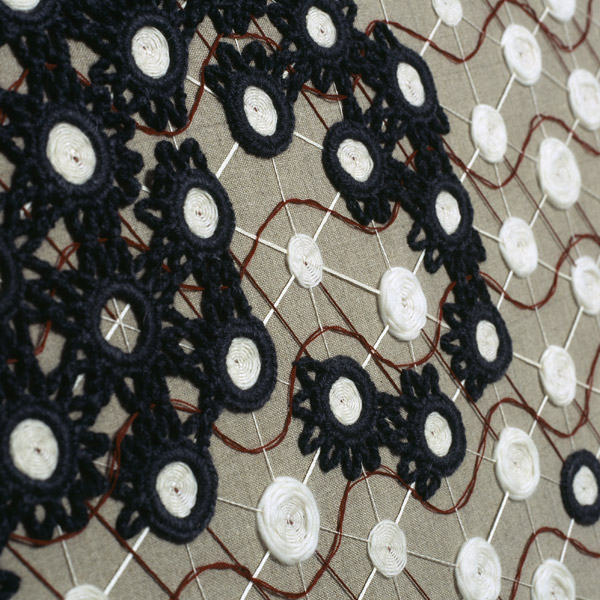
Two pieces from The Strange Quiet of Things
Misplaced will be exhibited as part of Momentum.
This exhibition will tour
Australia until December 2010. Dates and venues can be seen here.
Momentum identifies artists on the move, embracing the future
with works that surprise and inspire ... This exhibition will provide
audiences with a focus on the finest and most exploratory aspects of
contemporary fibre textile practice.
The Strange Quiet of Things Misplaced was
first exhibited at Breadbox
Gallery in Perth, Western Australia from April 18-May 04,
2008.
A limited edition book was also produced
in support of the exhibition.

The Strange Quiet of Things Misplaced #16 (detail)
Photo: Christopher Young
|